

Canby Mortgage Update: Rates Touch a Four-Week Low as Inflation Cools and Fed Minutes Loom
Freddie Mac's weekly average slipped to 6.67% on Thursday after July inflation cooled a tick and retail sales posted their biggest drop in over a year. Here is what Wednesday's Fed minutes could add, and how the week reads in Canby, where the fair is in town and the home value data needs a careful eye.
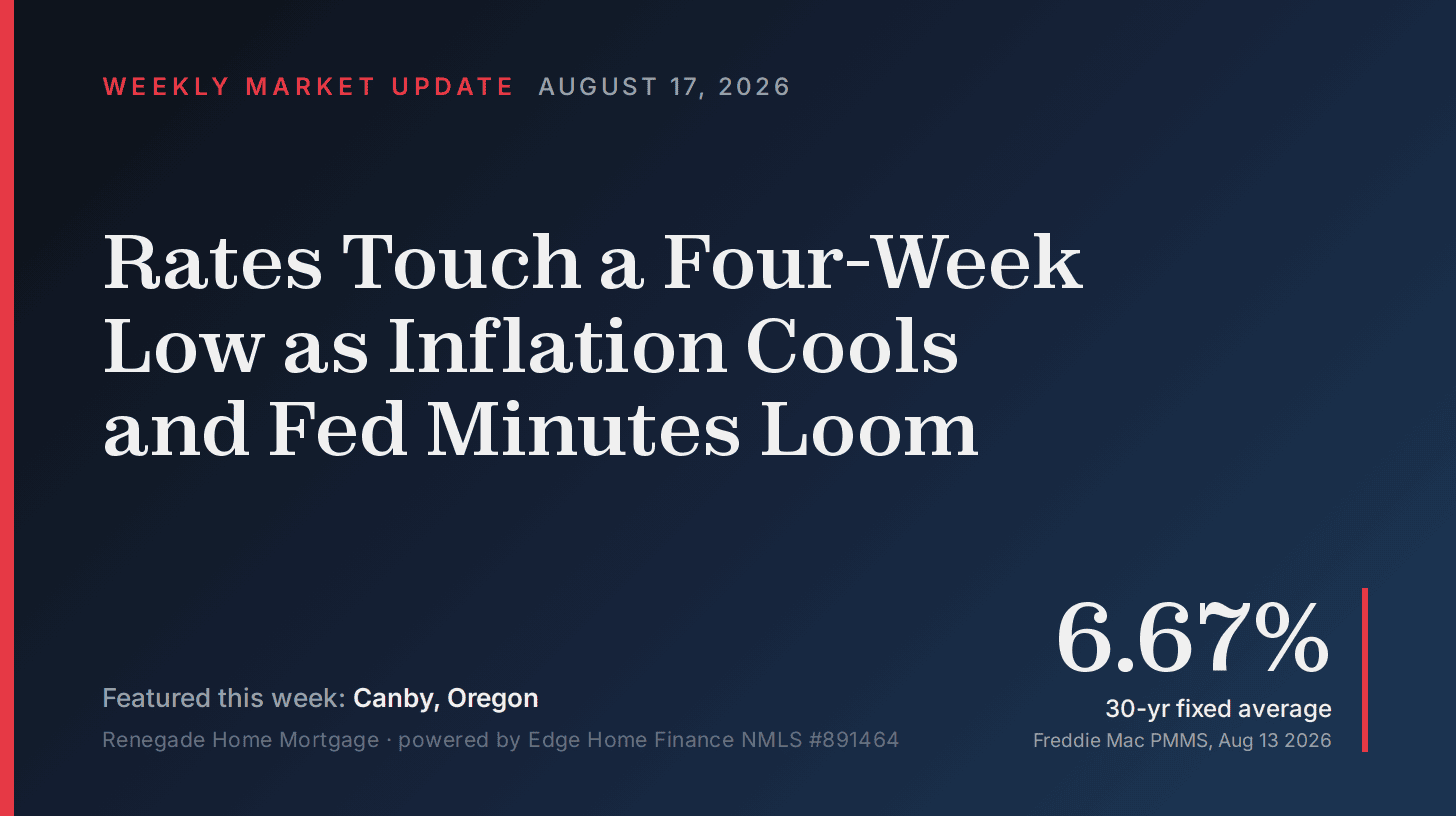
Canby takes the local slot this week, and the timing could not be better: the Clackamas County Fair and Canby Rodeo open Tuesday, and the rate market just handed borrowers its friendliest week since mid July. Last week every major data release leaned the same direction, toward cooling, and mortgage rates drifted to four-week lows. This Wednesday the Fed publishes the minutes from its most divided meeting in a decade. Below: the data, the rates, the minutes, the metro, and why the loudest number in Canby's housing data deserves the least trust.
Did Cooler July Inflation Take a September Rate Hike Off the Table?
Not off the table, but further from it. July CPI rose 0.1% for the month and 3.4% for the year, down from June's 3.5%, per the Bureau of Labor Statistics release on August 12. Markets trimmed the odds of a September hike, and mortgage rates eased to their lowest levels in four weeks.
The details were as friendly as the headline. Core CPI, which strips out food and energy, rose 0.2% for the month. Then Thursday's producer price data landed even softer: the index for final demand was unchanged in July, with a 0.7% drop in goods prices offsetting a 0.2% rise in services (Bureau of Labor Statistics). Producer prices are the pipeline that feeds consumer prices, so a flat month there buys credibility for the disinflation story in a way one CPI print alone cannot.
Friday added the consumer to the picture. July retail sales fell 0.6% from June to $763.6 billion, the biggest monthly drop in more than a year, against forecasts for a small gain (Census Bureau). Sales were still up 5.0% from a year earlier, so this is a consumer choosing spots rather than collapsing, but the direction matters. Ten days ago payrolls went negative, a story we covered in the Milwaukie edition, and now spending is flinching too. That is not an economy the Fed hikes into, whatever the last inflation holdouts prefer.
Where Do Mortgage Rates Stand This Week?
Freddie Mac's weekly survey, released August 13, put the 30-year fixed average at 6.67%, down from 6.69%, with the 15-year at 5.96% (Freddie Mac). The daily Mortgage News Daily index touched 6.69% Thursday, its lowest since July 17, before closing the week at 6.71%.
A year ago the 30-year survey average read 6.58%, so the market still sits slightly above its own shadow. But the week-to-week trend has turned: the survey has caught the drift that started with the August 7 jobs report, and Thursday's flat producer price reading pulled daily rates down again before a small Friday bounce. Freddie Mac's chief economist noted that purchase and refinance applications are already responding to even modest improvement, which tells you how much demand is parked just below the surface.
Zoom out and the summer range is intact. The 30-year average has spent the whole season between roughly 6.4 and 6.7%, and it just stepped back from the top of that band toward the middle. Nobody should plan around a collapse. The realistic prize, the one this week delivered, is an entry point measurably better than two weeks ago, with two more catalysts on the calendar before month end.
The Week Ahead: Fed Minutes Wednesday, Then Jackson Hole
This week is light on data and heavy on Fed. Housing starts and building permits arrive Tuesday, and then the main event lands Wednesday at 11 AM Pacific: the minutes from the July 28 and 29 meeting (Federal Reserve). That is the meeting where the committee held its policy rate at 3.5 to 3.75% on a 9 to 3 vote, with Cleveland's Beth Hammack, Minneapolis's Neel Kashkari, and Dallas's Lorie Logan all dissenting in favor of a hike, the most dissents at a single meeting since 2016. We broke down that split in the divided Fed post.
The minutes matter because they show how close the argument actually was. If the hawks nearly carried the room, the soft data since then is the only thing standing between borrowers and a September surprise. If the dissent was a loud minority and the committee's center is more worried about the labor market, September is probably settled already. Bond traders will read it accordingly, and mortgage rates will move with them.
Behind the minutes sits a bigger stage. The Kansas City Fed's annual Jackson Hole symposium runs August 27 to 29 (Federal Reserve Bank of Kansas City), and Chair Kevin Warsh delivers his first Jackson Hole keynote as Fed chair on the morning of Friday, August 28. A new chair's first Jackson Hole speech carries the weight of a formal meeting. Between the minutes and that speech, the next two weeks will tell us more about the September 15 and 16 decision than any data release will.
The Portland Metro Picture in Mid August
The metro data this month describes a market that is busier than it is expensive. The latest snapshots:
- Median sale price: $555,000 for the Portland metro in July, essentially flat year over year, with the average at $632,500, up 1.7%, per the July RMLS Market Action report (RMLS Market Action).
- Volume: closed sales rose 8.1% in July, the fastest sales pace of the year.
- Inventory: 3.3 months of supply, up slightly from June's 3.1 but still below last July's 3.7.
- Values: Zillow's model puts the typical Portland-Vancouver-Hillsboro home value at $534,614, down 1.2% over the past year (Zillow), and Redfin's trailing measure for the city of Portland reads $535,000, down 1.7%, with the median listing going pending in about two weeks (Redfin).
Put those together and the story holds from last month: prices flat to slightly soft, transactions up meaningfully, and supply tight enough that well-priced homes still move quickly. Sellers have not lost the ability to sell. They have lost the ability to overprice, which is a different thing.
Is Canby Really Up 20% in a Year?
Almost certainly not, and the number is a useful lesson in small-market data. Zillow's smoothed index puts Canby's typical home value at $554,473 and shows it up 20.2% over the past year (Zillow), in a metro where the same model shows values down 1.2%. Treat the level as the signal and the jump as noise.
Here is why. Canby is a city of roughly 18,000 people between the Willamette and Molalla rivers on Highway 99E, and its housing stock runs from downtown cottages near Wait Park to new construction on the edges to multi-acre farm and estate properties at the city line. In a market that size, a few months heavy on acreage closings can bend even a smoothed index, and boundary choices decide which properties count as "Canby" at all. The list side tells the same mix story from the other direction: July's median list price sat near $674,000, and homes spent a median of 58 days on market, about 10% fewer than a year earlier (Movoto). A $120,000 gap between the value index and the median listing is not a contradiction. It is what happens when the homes being listed skew larger and newer than the homes the city is made of.
So here is the honest read. A typical Canby house trades somewhere between the mid $500,000s and the mid $600,000s depending on size, age, and land. Market times run longer than Portland's two weeks because acreage always moves slower. And no serious measure supports pricing a listing as if the whole town appreciated 20% since last summer. Every part of that range sits comfortably under the Portland metro's $832,750 conforming loan limit, which keeps financing simple: conventional, FHA, VA, and renovation programs all work here, and jumbo only enters the conversation on the larger estate properties.
What Does This Mean for Canby Buyers and Sellers?
Whether you are shopping the walkable blocks in the Canby and Trost elementary attendance areas near downtown, newer construction out toward Knight and Eccles, or acreage in the Carus and Ninety-One zones south and east of town, the whole 97013 sits in the Canby School District and inside that simple financing band. Three specific implications this week:
- Buyers: use a quiet week to get current. Rates just touched four-week lows, and Wednesday's minutes and the August 28 Jackson Hole speech can each extend the improvement or erase it. A current pre-approval is what lets you act on a good morning instead of watching it pass. Start with the Canby mortgage page for the local detail.
- Sellers: price to closed comps, not to an index headline. If a listing agent justifies a price with "Canby is up 20% this year," ask for the last 60 days of closed sales on comparable homes instead. The metro is flat, your buyers are payment-sensitive, and the homes selling in 58 days are the ones priced to the recent comps in their own attendance area.
- First-time buyers: Canby's price point keeps every door open. A mid $500,000s target works with conventional, FHA, and VA financing, and Oregon's down payment assistance can stack on top for eligible buyers. Run payments at different price points in our calculators, then compare loan programs before you tour a single house.
Deciding which part of town fits? The Canby neighborhoods guide breaks the city down by elementary attendance area, from Trost and Knight to Lee, Eccles, Carus, and Ninety-One, including how each zone prices and what the school boundaries mean for resale.
Around the Community: Fair Week in Canby
This is the biggest week of Canby's civic calendar, verified against organizer listings:
- Clackamas County Fair and Canby Rodeo, Tuesday August 18 to Saturday August 22: the county fair at the Clackamas County Event Center, 694 NE 4th Ave., with carnival rides, livestock shows and competitions, live entertainment on three stages, and five nights of PRCA rodeo (Clackamas County Fair and Event Center).
- Canby Farmers Market, Saturdays 9 AM to 1 PM: the market runs every Saturday through October in downtown Canby on N Holly Street, with produce, flowers, food, and live music (City of Canby).
- Canby's Big Night Out Street Dance, Friday August 28: the end-of-summer street dance at 2nd and Grant in downtown Canby (City of Canby).
- Cutsforth's Cruise-In, Saturday August 29, 9 AM to 2 PM: one of the region's largest classic car shows fills Wait Park and the surrounding downtown blocks, free for spectators (City of Canby).
Oregon Housing Programs and Policy
A quiet week in Salem, so the item worth repeating is the standing one. Oregon Housing and Community Services offers down payment assistance of up to $60,000 or 20% of the purchase price, whichever is less, for eligible first-time and first-generation buyers at or below 100% of area median income, with a quarter of funds reserved for Oregon veterans (OHCS). Buyers complete homebuyer education and work with a certified housing counselor, and the assistance pairs with conventional, FHA, and VA loans. At Canby's price point that program does real work, and checking eligibility is a standard part of any pre-approval conversation with us.
Three Frameworks for the Week Ahead
- If you are house hunting: treat Wednesday at 11 AM Pacific as this week's event. The minutes can move rates a few basis points in an afternoon, and the direction depends on how hawkish the room really was in July. Have the pre-approval current before then, and know which listings you would move on if the read is friendly.
- If you are weighing a refinance: four-week lows are exactly when the scenario should already be built. Know the rate at which your breakeven works on real closing costs, set the trigger with your lender, and let the minutes and Jackson Hole come to you. Application data shows borrowers responding to moves this small, so the prepared ones are already transacting.
- If you are listing this fall: spend fair week on pricing homework, not on the index headline. Pull closed sales from the last 60 days in your own part of Canby, price against those, and consider a seller-funded temporary buydown as your lead concession. With buyers this payment-sensitive, a buydown widens your pool more than the same dollars off the price.
The Bigger Picture
Here is the read. Two weeks ago the labor market cracked. This week inflation cooled, producer prices went flat, and the consumer blinked. Every major release since the Fed's three-dissent meeting has strengthened the case for holding, and the burden of proof has quietly shifted from the doves to the hawks. Wednesday's minutes tell us how heavy that burden was inside the room. A new chair's first Jackson Hole speech tells us where he wants to carry it.
For Canby, the practical version is simpler. Rates are at their friendliest in a month, the local market is balanced, and the loudest number in the local data, that 20% appreciation figure, is the one to trust least. Price to real comps, finance inside the conforming limit, and use fair week to get your file ready for whatever Wednesday brings. Markets like this reward the prepared and punish the anchored.
If you want help getting minutes-ready, pressure-testing a Canby listing price against real comps, checking OHCS eligibility, or building a refinance trigger, Renegade Home Mortgage is here. Schedule a free 15-minute consultation or call us at (503) 974-3571. No pressure, just straight answers from your neighbors up the road.
Frequently Asked Questions
What is the average 30-year mortgage rate right now?
Freddie Mac's weekly survey put the 30-year fixed average at 6.67% on August 13, 2026, down from 6.69%, with the 15-year at 5.96%. Mortgage News Daily's daily index touched 6.69% Thursday, its lowest since July 17, and closed the week at 6.71%. Both are national averages, not quotes.
Did the July 2026 CPI report change the odds of a Fed rate hike?
It lowered them. July CPI rose 0.1% for the month and 3.4% for the year, down from 3.5% in June, and producer prices were flat. Three Fed officials voted to hike in July, so Wednesday's meeting minutes will show how close the committee actually came.
What is the typical home price in Canby, Oregon?
It depends on the measure. Zillow's smoothed index puts Canby's typical home value at $554,473, while the July median list price sat near $674,000. Canby is a city of about 18,000, so single readings swing on mix. Most Canby homes trade between the mid $500,000s and the mid $600,000s.
Do Canby buyers need a jumbo loan?
Rarely. The 2026 conforming loan limit for the Portland metro is $832,750, well above Canby's typical values, so conventional, FHA, VA, and renovation financing all work at Canby price points. Jumbo only enters the picture on larger acreage and estate properties.
When is the 2026 Clackamas County Fair and Canby Rodeo?
August 18 to 22, 2026 at the Clackamas County Event Center, 694 NE 4th Avenue in Canby. The week includes carnival rides, livestock shows, live entertainment on three stages, and five nights of PRCA rodeo.
Disclaimer: The information in this article is current as of August 17, 2026 and is provided for educational purposes only. It does not constitute financial, legal, or mortgage advice. Mortgage rates and market conditions change frequently. Any rates referenced are published national survey averages, not an offer of credit or a quote from Renegade Home Mortgage. Contact a licensed mortgage professional for guidance specific to your situation. Renegade Home Mortgage powered by Edge Home Finance NMLS #891464. Michael Neef NMLS# 227081. Equal Housing Opportunity Lender.